On this page
Aquascape
How to pair foreground, midground, background plants
Foreground, midground, and background are the basic layers of planted-tank scaping: foreground low, midground transition, background tall—clear layers give depth. Done well, a small tank feels large; done poorly, even a big tank looks flat, crowded, messy.
Why layers matter
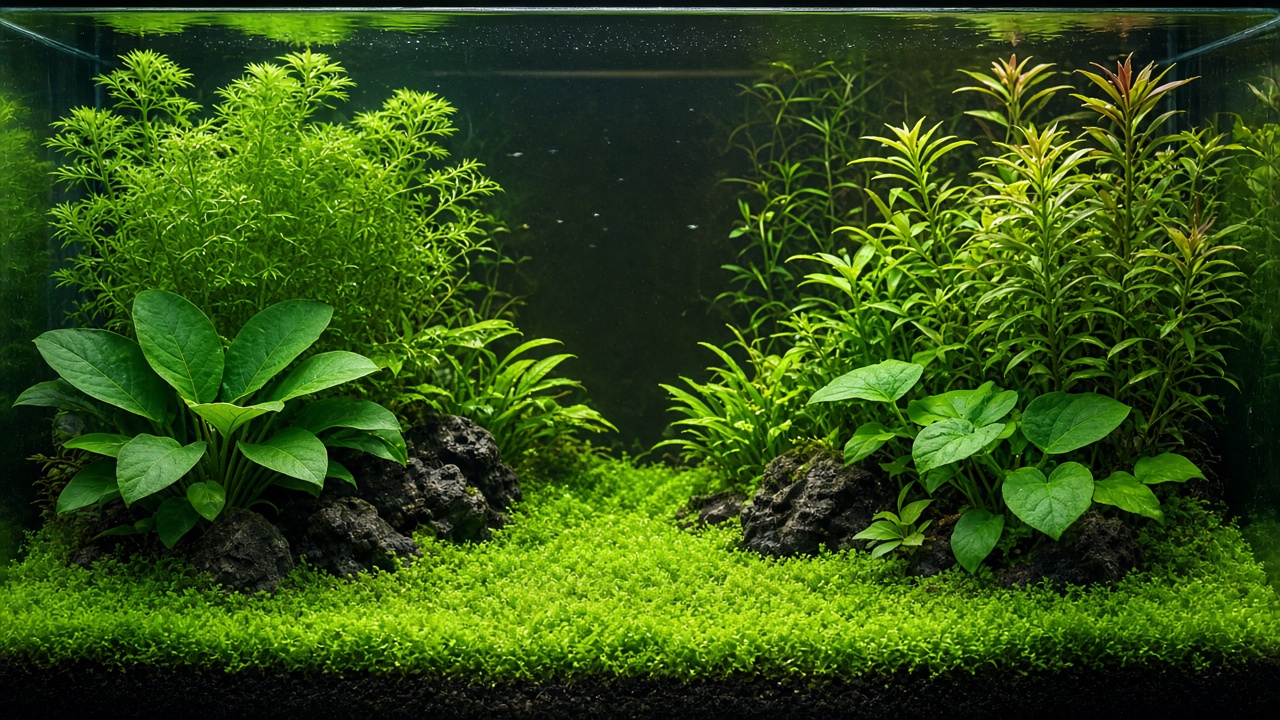
Layering is essentially creating visual depth and guiding the eye. Viewing from the front, foreground stays low and open, midground bridges, background rises tall and dense—the eye naturally moves front to back, and spatial sense emerges. If front, mid, and back all hold the same-height plants, it looks like a green wall: flat, dull, no layers.
Layering also helps you:
- Use the light gradient efficiently: Substrate at the front gets the strongest light, back slightly less—matching carpet-plant and stem-plant needs.
- Manage different growth rates: Foreground carpets grow slowly, midground stems grow fast; planting them separately makes trimming each easier, no mutual blocking.
- Support layouts: Concave, convex, triangle, island layouts set the silhouette with hardscape; plant layers fill those shapes and reinforce height contrast.
What goes in each layer?
Foreground
Height: 2–8 cm, carpet or creeping plants that hug the substrate.
Common species: HC Cuba, dwarf hairgrass, Staurogyne repens, glosso, hydrocotyle, fissidens, mini pellia.
Light needs: Most carpets are sun-loving, requiring medium-high light (substrate PAR 50+) + CO₂ to spread well; a few like mini pellia and fissidens tolerate low light.
Growth rate: Lateral spread faster than vertical, but overall slower than stems. Full carpet typically takes 1–3 months.
Role: Lay an open "ground" that gives the eye a landing spot and gives fish swimming room. Foreground negative space (open sand or thin carpet) is standard for island and concave layouts.
Midground
Height: 10–25 cm, medium stems, cluster plants, small low-light species.
Common species: Small Anubias, crypts, mini swords,Rotala 'Bonsai', Ammannia gracilis, trimmed Rotala (height-controlled), glosso (transition zone), dwarf swords.
Light needs: Low-light plants (Anubias, crypts) work under low light; sun-loving stems (Rotala, Ammannia) need medium-high. Midground is the transition zone from strong to weaker light—choose by specific placement.
Growth rate: Stems fast, low-light slow. Rotala or Ammannia can grow 5–10 cm per week, needing frequent trims; Anubias and crypts add a few leaves over months.
Role: Bridge the gap, connect foreground to background, fill blanks, soften hardscape lines. Rich midground keeps the tank from looking "only two tiers."
Background
Height: 30 cm and up, tall stems, large low-light plants, dense clusters.
Common species: Green Rotala, red Rotala, Ludwigia,Alternanthera, Vallisneria, Limnophila, large Anubias, large swords, narrow-leaf Java fern.
Light needs: Background is partly shaded by foreground and midground, but tall stem tops still catch strong light. Red stems (red Rotala, Ludwigia) suit the back—tops get good light, lower sections tolerate slightly less. Low-light plants (large Anubias,Java fern) are not picky; background shadow zones work.
Growth rate: Stems extremely fast, 10–20 cm per week—must top or replant regularly. Large low-light plants slow, adding a ring of leaves over months.
Role: Lift the tank's height, hide the back wall (heater, filter tubes), act as visual backdrop. Dense background makes foreground and midground outlines stand out.
How layers pair with layouts
Layers and four classic layouts work together: layouts set the silhouette, layers fill the content.
Concave: center open, sides high
- Foreground: Central open area carpeted or left as open sand, emphasizing negative space.
- Midground: Plant in front of hardscape on both sides, connecting foreground to background.
- Background: Dense planting on both rear sides, but leave the center low or empty—do not fill in the concave.
Convex: center high, sides low
- Foreground: Keep sides low or open to highlight the central peak.
- Midground: Cluster around central hardscape, forming a focal point.
- Background: Plant tall in the center-back, keep sides low; or run a full background wall to make the central rise more obvious.
Triangle: plant along the slope
- Foreground: Low side carpeted or open, high side can hold slightly taller transition plants.
- Midground: Distribute along the slope, density increasing with height.
- Background: Dense on high side, empty or sparsely accented on low side, reinforcing the diagonal.
Island: negative space first, accent edges
- Foreground: Wide open sand or thin carpet; negative space is the point.
- Midground: Plant a few small species or moss around the central stone group, without breaking the minimalist feel.
- Background: Can skip tall plants entirely (pure Iwagumi), or plant a thin line of fine-leaved grass on the back wall—background without stealing focus.
Beginner pairings by tank × light
These are conservative starting directions. You can swap species, but keep the framework: foreground low, midground transition, background tall.
Nano / small (under 30 cm) × low light
- Foreground: Mini pellia or fissidens thin carpet, or open sand
- Midground: Small Anubias, crypts—1 or 2 clumps
- Background: Narrow-leaf Java fern, smallVallisneria
- Traits: All low-light; no CO₂ needed, low light works, slow growth, easy maintenance.
Small (30–60 cm) × medium-high light + CO₂
- Foreground: HC Cuba or dwarf hairgrass full carpet
- Midground: Rotala 'Bonsai', glosso transition
- Background: Green Rotala or Limnophila dense plant
- Traits: Mostly sun-loving, fast growth, good color; frequent trimming and fertilization needed.
Medium-large (60 cm+) × medium-high light + CO₂
- Foreground: HC Cuba or Staurogyne repens wide spread
- Midground: Ammannia gracilis, mini swords, cryptsmixed—rich layers
- Background: Red Rotala, Ludwigia, Alternanthera for color focus; green Rotala or Vallisneria fill background
- Traits: Lots of space for complex mixed planting; red-green contrast for color pop; high maintenance load.
Common mistakes
- Planting tall stems in all three layers—layers vanish: Beginners are drawn to stems for "easy to grow, fast"—result: front is Rotala, mid is Rotala, back is Rotala. One month later the whole tank turns into a green wall, no front-to-back separation, no depth. Foreground must stay low.
- Forcing carpets in low-light tanks: HC Cuba and dwarf hairgrass are sun-loving carpets; substrate PAR below 40 makes them grow extremely slowly, fail to creep, and rot easily. Without medium-high light + CO₂, skip carpets—use moss or open sand instead.
- Midground plants grow too tall and block background: If midground plants reach 30 cm+ without trimming, they fully hide the background. Either pick naturally short species (small Anubias,crypts) or top regularly to control height.
- Background too sparse—back-wall equipment exposed: One background role is hiding clutter. If you only plant a few Rotalastems, the heater and filter tubes are on full display. Background needs dense planting, or choose large-leaf low-light plants (largeAnubias, large swords) as a screen.
- Foreground carpet and background stems differ too much in growth rate—maintenance rhythm chaos: Carpets trim once a month, stems trim once a week. If the tank is all fast stems, trimming frequency is unbearable; if all slow low-light plants, full scape takes half a year. Beginners: try foreground carpet + midground low-light + background stem combo—fast and slow balance, upkeep manageable.
The aquascape studio images show layering effects; when planting for real, the borders between front, mid, and back need not be sharp—natural transitions work. For layouts see four classic layouts; for lighting see how to choose a suitable light; for CO₂ see how to choose a CO₂ system. Details worth adding? Tell us via Contact.
2026-10-10