On this page
Aquascape
Four classic layouts
Layout is the rough silhouette you see from the front when hardscape and plants stack up. These four layouts apply across freshwater biotopes—planted, blackwater, stream, rainforest vivarium front view—visual proportions only, not measured.
Why layout matters
Layout is essentially dividing the frame: where the focal point sits, how the transition zones guide the eye, and how much negative space (open area) to leave. The same stone and plants arranged as concave, convex, triangle, or island feel completely different. Lock the silhouette before the tank opens, then hardscape and plants follow the proportions.
These four silhouettes are mainly for freshwater biotopes (planted, blackwater, stream, rainforest); microscape and reef tanks can borrow the silhouette ideas, but material choices and negative-space handling differ.
Four classic layouts, each with traits:
- Concave: high on both sides, low in the middle—leaves a clear central space or swim lane.
- Convex: high in the center, low on the sides—hardscape and plants gather in the middle as a focal point.
- Triangle: one side high, the other low—diagonal composition, eye moves along the slope.
- Island: central hardscape group as an island, surrounded by open sand or carpet—emphasizes negative space and hardscape detail.
Concave layout
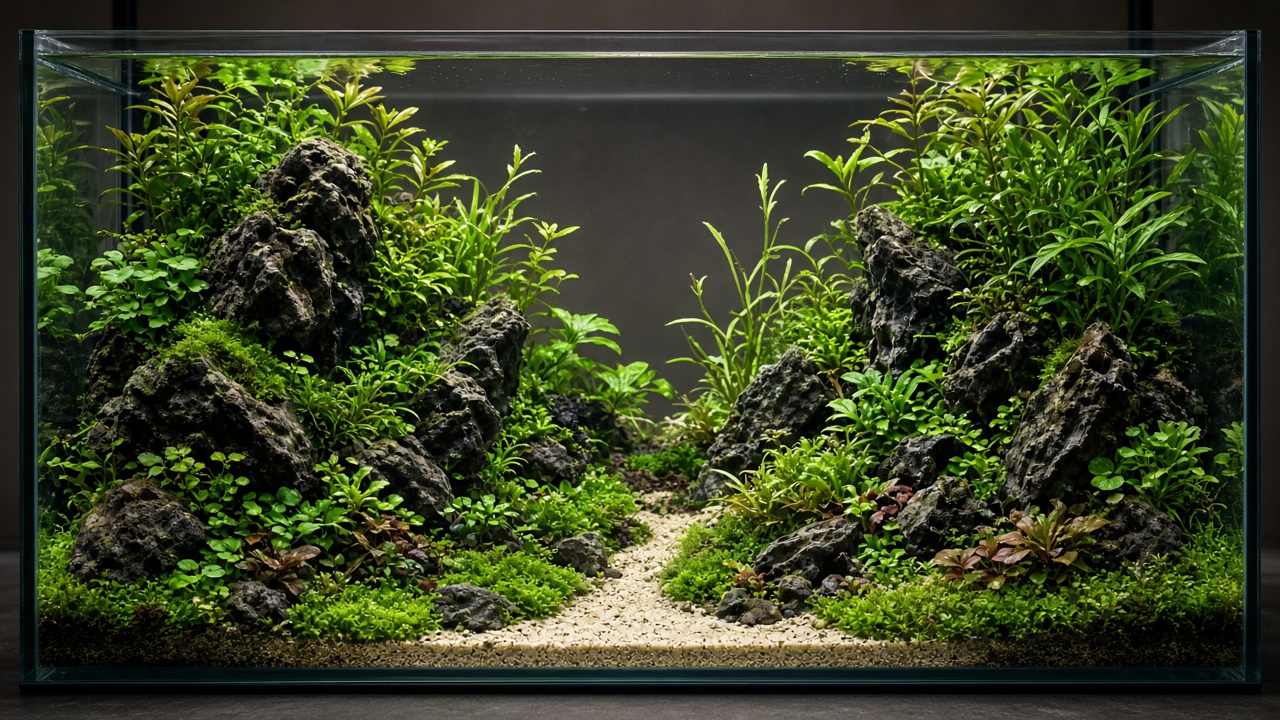
Concave is the most common planted-tank layout. Both edges stack hardscape and plants high; the middle stays low and open, like a valley or river. The eye is drawn to the central open space.
Tip: Place the valley off-center—left or right feels more natural. Set a primary peak (higher, denser) and a secondary peak (slightly lower) on the sides, then use the central open area or foreground carpet to guide the eye from one side to the other.
Fits
- Layouts wanting depth and emphasis on openness
- Fish need clear swimming room
- Prefer watching fish in the open, not hidden behind scape
- Small and mid tanks wanting to feel larger
Hardscape and plants
- Place one hardscape group (stone or wood) on each side; height drops toward the middle
- Front center can be carpet or open sand; plant stem or large low-light species on the sides
- Do not pile the middle high, or the concave disappears
Across biotopes
- Blackwater: wider central opening, wood spreads toward sides—emphasizes horizontal stretch and negative space
- Stream: low center can be stream sand simulating a riverbed, banks pile stone and aquatic plants
- Rainforest vivarium: background wall often runs full height; concave foreground leaves a viewing corridor, root masses or epiphytes on the sides
Watch
- Height and density should vary slightly between sides—one a bit higher or denser avoids stiff symmetry
- Central opening should take at least a third of tank length; too narrow turns into two piles with a crack
Convex layout
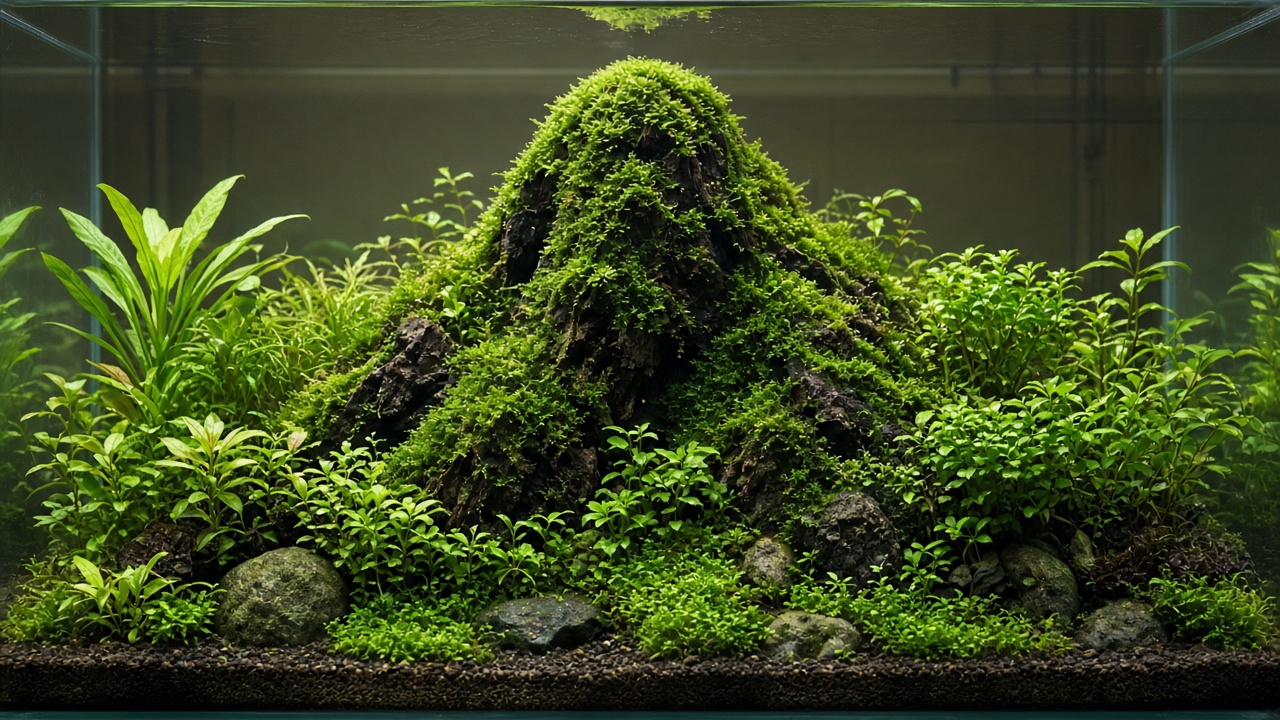
Convex is the opposite of concave: middle piles high into a hill or island, sides stay low or empty. The eye locks on the central rise. Fits layouts wanting a single visual focus. Cube or tall tanks suit convex especially well—when the frame is not wide, a concentrated focal point has more impact.
Fits
- Building a main mountain or root-mass island
- Cube or tall tanks; concave sides have no room to spread
- Prefer focused, compact visual effect
- Rainforest root mass, Iwagumi single peak
Hardscape and plants
- Place main stone or large wood in the center, tapering to the sides
- Plant epiphytes or small foreground on the high ground; sides can be open sand or thin substrate
- Main feature needs a clear peak; avoid flat tops
Across biotopes
- Blackwater: one large centerpiece wood as the visual anchor, sides thin substrate or left empty
- Stream: central stone pile as a rapid outlet or stone-island; feels like flow spreads from the center outward
- Rainforest vivarium: central root mass or tree fern as main feature; background can run full wall, foreground stays low with moss or leaf litter
Watch
- Central rise easily hides the back; fish behind it vanish. If the tank is shallow, this gets worse
- Maintenance is harder; plants on top are hard to prune when you cannot reach—use long tweezers
Triangle layout
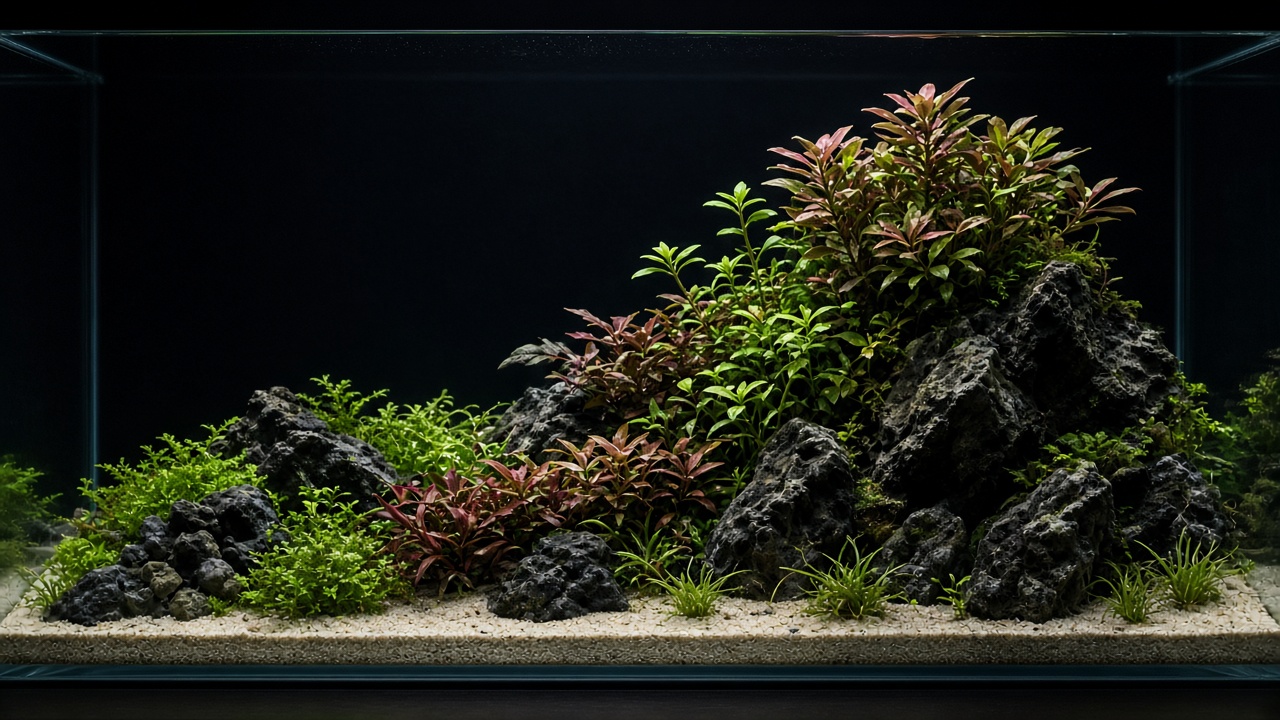
Triangle stacks one side high, the other low—a diagonal layout. Can be left-high right-low, or reversed. The eye moves along the slope from low to high, giving direction and motion. Beginner-friendly: triangle is visually stable, does not easily look empty or messy—one of the easiest layouts for a first scape.
Fits
- Asymmetric layouts with flow
- Long or shallow tanks
- One side against a wall or window; tank viewed from one direction
- Stream, slope, or waterfall-inspired scapes
- First-time scapers wanting a safe visual result
Hardscape and plants
- Pick one side as the high edge, stack stone or stand wood; other side stays low or holds only small rocks
- Substrate tilts too—thick on the high side, thin on the low
- Plant density follows terrain: dense on the high side, sparse or open on the low
Across biotopes
- Blackwater: wood angles from high side toward low, mimicking natural fallen-tree forms
- Stream: most natural layout—high side is the source or bank, low side is downstream or riverbed, slope is flow direction
- Rainforest vivarium: high side builds background wall + epiphyte zone, low side leaves foreground viewing area, slope carpeted with moss or ferns
Watch
- Slope angle not too steep—substrate slides. Not too flat either, or the triangle fades
- Hardscape and plant weight on the high side compacts substrate; check regularly for collapse
Island layout
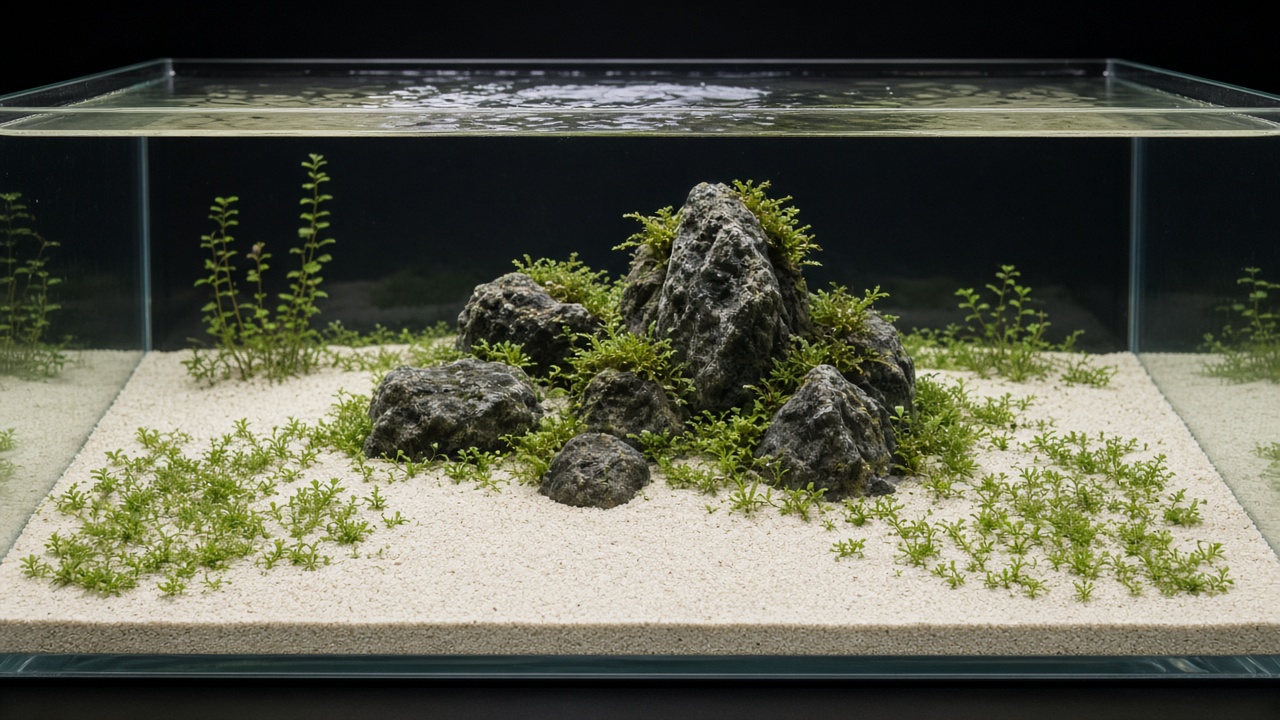
Island places one carefully chosen hardscape group (usually stone) in the center, surrounded by wide open space—open sand, thin cosmetic sand, or only low carpet. This is the most common Iwagumi composition, emphasizing hardscape form, texture, and placement over plant density.
Fits
- Minimalist, Zen-inspired Iwagumi layouts
- A few beautiful stones you want as the absolute focus
- Prefer negative space over dense planting
- Small tanks work too—no complex layers needed
Hardscape and plants
- Place a main stone (often seiryu or similar rock) in the center, with 2–4 supporting or accent stones forming a group with clear hierarchy
- Follow the odd-number rule (1 main + 2 support, or 1 main + 4 support); avoid symmetry and even counts
- Leave wide open sand around the island, or plant only low carpets like HC Cuba or dwarf hairgrass—no tall stems
- Can skip plants entirely for pure open sand + stone—more minimalist
Across biotopes
- Blackwater: central small wood group or root bundle, surrounded by open sand or thin leaf scatter—emphasizes horizontal negative space and tannin tones
- Stream: central stone group mimics rocks or shallows in a stream, surrounded by fine sand or pebbles, can add sparse emergent-plant accents
- Rainforest vivarium: island is less common, but you can do a central root mass + surrounding low moss or leaf litter for a minimalist foreground
Watch
- Stone selection and placement make or break the layout; shape, angle, spacing all need many adjustments—one stone wrong can ruin everything
- Large open sand makes any debris, algae spot, or uneven substrate obvious; upkeep must be meticulous
- Wide negative space means "nowhere to hide"—hardscape must hold up under scrutiny, cannot rely on plants to mask flaws
- If the carpet grows unevenly or sparsely, it stands out badly across the wide foreground
Quick comparison
| Layout | Visual trait | Best for | Easy mistake |
|---|---|---|---|
| Concave | Open, depth, clear lanes | Small/mid tanks, many fish, want space | Perfect symmetry, narrow opening |
| Convex | Focused, compact, single peak | Cube/tall tanks, Iwagumi, rainforest root | Flat top, hides back, hard upkeep |
| Triangle | Asymmetric, directional, dynamic | Long tanks, stream feel, one-side view, beginners | Too steep, substrate slide, collapse |
| Island | Minimalist, wide negative space, hardscape lead | Iwagumi, small-tank minimal | Stone placement wrong, uneven sand, no hiding flaws |
Layout by tank size
Nano / small (20–60 cm)
- Concave, triangle, island fit better: small space; concave pulls depth, triangle gives the eye a landing, island uses minimalism to hold a small tank.
- Convex needs simplifying: do not pile the middle too high, or one mountain fills the tank and nothing remains.
Medium (60–90 cm)
- All four layouts open up; pick by preference and biotope.
- Concave can spread wider with enough depth on the sides; convex can build a complex main mountain; triangle can pull a clear diagonal; island has room to spread the stone group and negative space.
Large / XL (90 cm and up)
- Concave is most common: large tanks let each side hold a scene, middle stays broad and open for fish.
- Convex needs supporting scape: a lone peak in a big tank looks isolated; add small features or foreground on the sides.
- Triangle watch proportions: long slopes in large tanks slide more easily; use barriers or gentler grade.
- Island watch negative-space ratio: a central stone group may look too small in a large tank—either scale up the stones or transition with carpet, avoiding too much emptiness.
Things to watch
- Layout sets silhouette, not detail: Do not obsess over each stone's angle at the start. Use rough high-low relationships to lock concave, convex, triangle, or island; tune details later.
- Adding substrate before hardscape is secure: Once substrate goes in, hardscape is hard to move. Dry-fit, lock the hardscape, then add substrate. Island especially needs many stone-position adjustments.
- Planting too dense; layout vanishes: Plants grow. Leave space at the start; do not let dense planting bury the silhouette. The skeleton should stay visible. Island demands restraint—negative space is the point.
In the aquascape studio, try concave, convex, triangle, and island for visual effect. The rainforest studio can also try similar foreground compositions. For choosing hardscape, see hardscape by freshwater biotope. Details worth adding? Tell us via Contact.
2026-10-10