On this page
Aquascape
Brewing blackwater tea
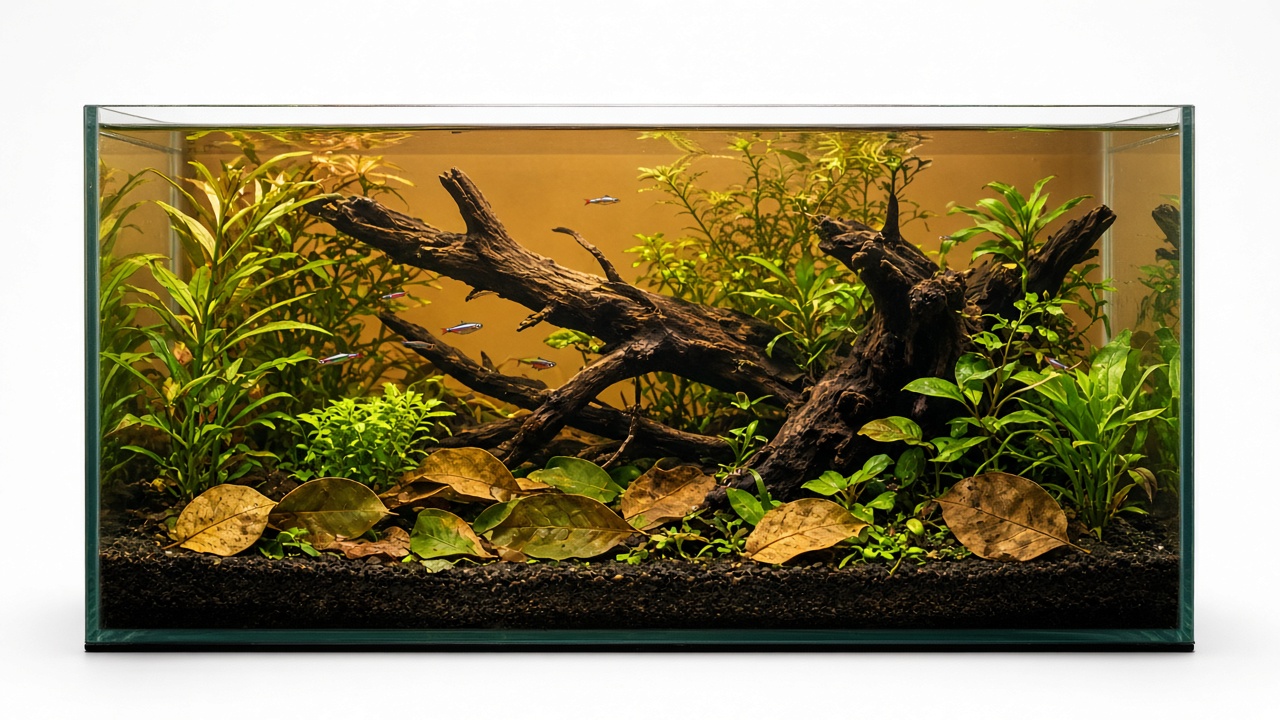
The tea-colored water of a blackwater tank comes from natural plant tannins—below: how to brew stable tea color with leaves, cones, and peat, plus pH, hardness, and fish compatibility.
What is a blackwater tank
A blackwater tank simulates Southeast Asian and South American rainforest stream water quality—water displays amber or tea color, pH is acidic (5.5–6.5), hardness low (GH < 5°dH), rich in tannins. This water quality comes from decaying leaves, branches, and fruits slowly releasing humic acid and tannic acid.
Why brew blackwater? Simulates native habitats, suitable for fish that prefer soft acidic water (dwarf cichlids, tetras, bettas, corydoras, plecos). Tannins have antibacterial properties, reduce stress, and enhance coloration. Tea-colored water also has unique aesthetic value—light passing through displays warm amber tones.
Blackwater ≠ dirty water: Tea color comes from dissolved organic matter, not suspended particles. Properly brewed blackwater is clear and transparent, just colored, not cloudy.
How to brew tea color: botanicals
The core of brewing blackwater is adding natural plant materials (botanicals) to slowly release tannins into water. Common materials:
Indian almond leaves (Catappa leaves)
Most common blackwater material. Dried leaves from Terminalia catappa, rich in tannins and flavonoids. After soaking, water turns tea-colored while lowering pH and GH.
Dosage: 1 medium leaf (~10–15 cm) suitable for 20–40 L water. Leaves sink after softening, color fades in 1–2 weeks, supplement with fresh leaves.
Pros: Cheap, readily available, stable effect; decayed leaves can feed fish and shrimp.
Cons: Deep color, rapid pH drop—beginners easily overdose.
Alder cones
Gentle blackwater material. Fruits from alder trees (Alnus), release tannins slower than catappa leaves, tea color lighter and more yellow.
Dosage: 2–3 small cones (~1–2 cm) suitable for 20–40 L water. Cones can remain in tank long-term, slowly releasing tannins.
Pros: Gentle, hard to overdose; small size, space-efficient; shrimp enjoy gnawing on them.
Cons: Lighter tea color, requires more quantity for deep color.
Peat / Humic acid
Powerful blackwater material. Peat moss or humic acid extract, extremely high tannin concentration, small amount produces deep color.
Dosage: Peat in filter bag, 1 small handful (~50 g) suitable for 40–80 L water; humic acid liquid per bottle instructions (usually 1 mL / 10 L).
Pros: Strong effect, low dosage; humic acid liquid offers precise dosing, no cloudiness.
Cons: Peat easily clouds water (must use filter bag); overdose causes pH crash (< 5.0), stressing fish.
Other materials
- Oak leaves, beech leaves: Similar to catappa, slightly lower tannin content, lighter tea color.
- Lotus pods, pecan shells: Decorative, slowly release tannins.
- Driftwood: Some driftwood (e.g., rhododendron, manzanita) releases tannins, but effect is weak and uncontrollable. Relying only on driftwood produces very light tea color.
Tannins, pH, and hardness
Tannins not only color water but also lower pH (acidify) and GH (soften). All three are interconnected and must be balanced.
Tannins → pH drop
Tannins are weak acids; dissolved in water they release hydrogen ions (H⁺), lowering pH. After adding catappa leaves or peat, pH typically drops from neutral (7.0) to 6.0–6.5; overdose can drop below 5.0 (most fish cannot tolerate).
Monitor pH: Beginners must use pH test strips or electronic pH meters regularly (1–2 times weekly). Target is pH 6.0–6.5 (suitable for most acid-loving fish). If pH < 5.5, immediately water change 30–50% to dilute tannins.
Tannins → GH drop (softening)
Tannins and humic acid chelate calcium ions (Ca²⁺) and magnesium ions (Mg²⁺) in water, lowering general hardness (GH). Tap water GH typically 8–15°dH (medium-hard to hard); after adding blackwater materials can drop to 3–6°dH (soft water).
Why soft water? Native tropical rainforest streams have extremely low GH (< 3°dH); fish in soft water have higher breeding rates, better coloration, longer lifespans. Calcium-magnesium in hard water interferes with fish osmoregulation, long-term health declines.
Balance recommendations
- Beginner target: pH 6.0–6.5, GH 4–6°dH, clear tea color (can see fish clearly).
- Advanced keepers: pH 5.5–6.0, GH 2–4°dH, deep tea color (simulates native habitat)—requires RO or purified water + mineral additives for precise adjustment.
- Avoid: pH < 5.0 or sudden pH drop > 0.5 units (fish will shock); GH < 2°dH (some fish calcium-deficient, skeletal deformities).
Dosing and water-change cadence
Tannin concentration must be adjusted gradually, not all at once. Below are experience-based starting doses and water-change recommendations:
Starting doses (per 50 L water)
| Material | Initial dose | Maintenance supplement | Notes |
|---|---|---|---|
| Catappa leaves | 1–2 medium leaves | Supplement 1 leaf every 1–2 weeks | Decayed leaves can remain or be removed |
| Alder cones | 3–5 small cones | Supplement 2–3 every 2–3 weeks | Gentle, beginner-friendly |
| Peat (bagged) | 30–50 g | Replace bag monthly | Must use filter bag, place in canister or hang-on |
| Humic acid liquid | 3–5 mL | Supplement 2–3 mL after water change | Precise dosing, recommended for advanced |
Water-change cadence
Blackwater tanks follow same water-change frequency as regular planted tanks—20–30% weekly. When changing water, note:
- New water must also be colored: If adding tap water directly, tea color dilutes, pH and GH also rise. Recommend pre-treating new water with blackwater materials (or use humic acid liquid to color), making new water similar to tank water.
- Match temperature: Keep new water within ±2°C of tank water to avoid thermal shock.
- Avoid large water changes: Blackwater tank water change > 50% causes sudden pH and GH swings, stressing fish. Stable small changes (20–30%) safer than large changes (50–70%).
Initial coloring process (new tank)
- Day 1: Add small amount of material (e.g., 1 catappa leaf or 3 alder cones), observe 24 hours.
- Day 2: Test pH and color. If pH > 6.5 and tea color light, continue adding material; if pH < 6.0, stop adding, wait 3–5 days to stabilize.
- Days 3–7: Test pH daily, after confirming stable at 6.0–6.5 add fish.
- After week 1: Enter normal water-change rhythm (20–30% weekly), regularly supplement materials to maintain tea color.
Fish that like blackwater
Fish whose native habitats are soft acidic water are best suited for blackwater tanks. Common species:
Dwarf cichlids
South American dwarf cichlids: Apistogramma cacatuoides, agassizii, borellii, ramirezi, altispinosa, etc. Prefer pH 5.5–6.5, GH 2–6°dH. Tea-colored water reduces aggression, enhances coloration, promotes breeding. Blackwater tanks are ideal dwarf-cichlid environments.
Tetras
South American tetras: Neon tetra, cardinal tetra, rummy-nose tetra, black neon, emperor tetra, etc. Native to Amazon blackwater rivers, prefer pH 6.0–7.0. Tea-colored background makes fluorescent colors more vivid.
Bettas
Wild bettas: Betta splendens wild types, show-quality wild-strain bettas. Prefer pH 5.5–6.5. Tannins have antibacterial properties, reduce fin rot.
Corydoras
South American corydoras: Panda, albino, peppered, bronze, etc. Prefer soft acidic water; in tea-colored water activity is high, lifespans long.
Plecos (Loricariidae)
Small plecos: Bristlenose plecos, otocinclus, zebra plecos, etc. Native to Amazon tributaries; blackwater environment enhances coloration, breeding rates.
Fish unsuitable for blackwater
- Fish that prefer hard alkaline water: African cichlids (e.g., Lake Tanganyika/Malawi cichlids), guppies, platies, swordtails—their native pH 7.5–8.5, blackwater tanks stress them, prone to disease.
- Large predatory fish: Flowerhorn, oscars, red devils, etc.—although can adapt to weak acid, their high waste production makes blackwater water quality hard to maintain.
Common mistakes
Over-acidification (pH < 5.0)
Symptom: Too many catappa leaves or peat added, pH drops to 4.5–5.0, fish show clamped fins, hide in corners, refuse food.
Cause: Tannin excess, water too acidic, fish body mucus and gills damaged.
Solution: Immediately water change 30–50%, dilute with tap water (tap water pH usually 7.0–7.5); remove some blackwater materials; add coral bone or crushed shells (small amount, ~10 g / 50 L) to buffer pH. After recovery (pH > 6.0) gradually add back materials.
Cloudy water (not clear)
Symptom: Water displays murky brown-yellow, can't see fish clearly, like muddy water.
Cause: Peat not bagged, scattered directly in tank; or too many decaying leaves, decomposition rate faster than filter can handle.
Solution: Peat must be bagged; pre-soak leaves 24 hours (lets initial rapid-release particles discharge first) before adding to tank; strengthen mechanical filtration (fine filter foam); water change 30% + add activated carbon to absorb (but carbon also removes tea color, remove after 1–2 days).
Unstable tea color (alternating deep and light)
Symptom: After water change tea color lightens, darkens again after a few days, repeats cyclically.
Cause: New water not colored during water changes; or irregular material addition (sometimes add, sometimes don't).
Solution: When preparing new water before water change, add humic acid liquid (or pre-soak leaves) to match new water color to tank water; regularly supplement materials (every 1–2 weeks) to maintain stable tannin concentration.
Only tea color, no acidification or softening
Symptom: Water beautifully tea-colored, but pH still 7.0, GH still 10°dH.
Cause: Used dye (e.g., blackwater extract, tea dye) instead of natural tannins—dyes only change color, don't adjust water chemistry.
Solution: If fish need soft acidic water, must use natural plant materials (catappa, alder cones, peat); if local tap water too hard (GH > 15°dH), must mix RO or purified water to reach target hardness.
Ignoring water changes (thinking blackwater doesn't need changes)
Misconception: Some believe blackwater tank tannins have antibacterial properties, can skip or reduce water changes.
Fact: Tannins cannot replace water changes—ammonia, nitrite, nitrate still accumulate, require regular water changes to dilute. Blackwater tanks follow same water-change frequency as regular tanks (20–30% weekly), just new water must be colored. Not changing water leads to high nitrate (> 40 ppm), chronic fish poisoning. See First month and Algae guide.
The core of blackwater tanks is gradual coloring + stable maintenance + pH monitoring—use natural plant materials to slowly release tannins, regularly test pH and GH, keep new water consistent with tank water during changes. For substrate selection, see Choosing substrate; for fish and water-quality compatibility, see Fish and plants. To preview the finished look, open the aquascape studio and generate an image.
Details to add? Tell us via Contact.
2026-10-11